


Blog | AI Solutions
The Complete Guide to Custom AI Development Costs in 2026
Learn how AI solution type, complexity, infrastructure, and deployment models influence pricing, and explore practical strategies to optimize development expenses while maximizing ROI.
- Blogs

Custom ai development cost 2026
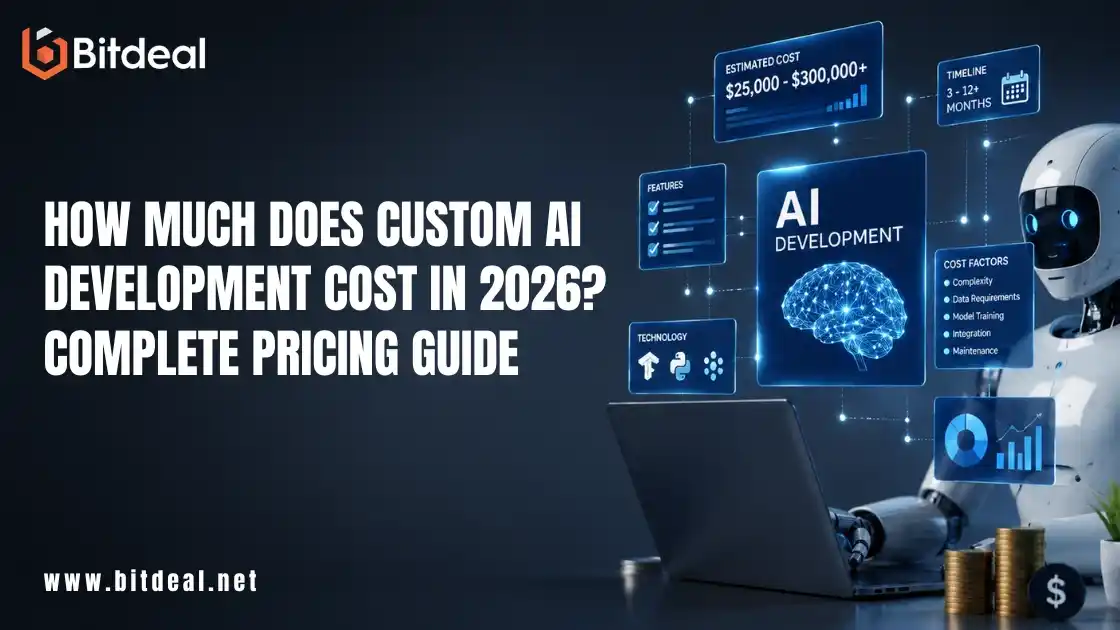
AI is no longer experimental; businesses across industries use custom AI to automate tasks, extract insights, and create new products. Custom AI development builds solutions tailored to a company’s data, processes, and objectives rather than using out-of-the-box tools. This blog explains what custom AI entails, the cost drivers in 2026, realistic price bands for project types, hidden costs to expect, and ways to optimize spending.
What Is Custom AI Development?
Custom AI development designs, trains, and deploys machine learning and AI systems specifically for a firm’s needs, combining data engineering, model development, and production deployment. It often includes data labeling, model selection or fine-tuning, MLOps, UI/UX, and integration with existing systems. The result is a bespoke solution chatbots, forecasting engines, vision systems, recommendation engines, or agentic platforms aligned to business KPIs.
Key Factors Affecting Custom AI Development Costs
Type of AI Solution
The solution type (NLP, computer vision, recommendation, forecasting, multi-agent) impacts required talent, compute, and data needs; more complex modalities raise costs. Vision and NLP often require large labeled datasets and specialized tooling.
Project Complexity and Features
Complex projects (real‑time inference, strict SLAs, multi modal inputs, advanced explainability) require senior engineers and more engineering hours, raising costs. Additional features include user management, analytics dashboards, MLOps pipelines add integration and testing work.
AI Model Selection
Using open-source models and fine-tuning cuts license fees but needs compute and expert tuning; proprietary foundation models may have high inference and licensing costs. Model size affects hardware needs and latency engineering.
Data Collection and Preparation
High-quality labeled data is often the dominant cost: collection, cleaning, annotation, and augmentation take time and human effort. Specialized labeling (medical, legal) demands domain experts and increases per-sample costs.
Third-Party Integrations
Integrating with ERPs, CRMs, cloud APIs, or domain platforms requires connectors, custom adapters, and security work each integration is an incremental cost. Off-the-shelf connectors reduce time; bespoke integrations require API engineering and testing.
Infrastructure and Cloud Requirements
Compute for training and inference (GPUs/TPUs), storage, and networking determines cloud bills; real-time systems need low-latency architecture and higher costs. Choices include on-prem, cloud VMs, managed ML platforms, or hybrid each with different CAPEX/OPEX.
Custom AI Development Cost Breakdown in 2026
1. Basic AI Applications
Simple models and narrow scope rule-augmented automation, basic classification, single-task chatbots or dashboards with limited integrations.
Cost breakdown: USD 10k–50k (INR 820k–4.1M)
Discovery & requirements: USD 1k–3k (INR 82k–246k)
Data prep & labeling: USD 2k–10k (INR 164k–820k)
Model development & testing: USD 3k–20k (INR 246k–1.64M)
Integration & deployment: USD 2k–10k (INR 164k–820k)
First-year cloud & infra: USD 1k–7k (INR 82k–574k)
2. Mid-Level AI Solutions
Multimodal inputs or multi-feature projects recommendation engines, advanced NLP assistants, moderate real-time components, several integrations.
Cost breakdown: USD 50k–250k (INR 4.1M–20.5M)
Discovery & design: USD 5k–20k (INR 410k–1.64M)
Data engineering & annotation: USD 10k–60k (INR 820k–4.92M)
Model selection/fine-tuning: USD 15k–80k (INR 1.23M–6.56M)
MLOps, testing, security: USD 8k–40k (INR 656k–3.28M)
Deployment & integrations: USD 7k–30k (INR 574k–2.46M)
First-year infra & licenses: USD 5k–20k (INR 410k–1.64M)
3. Advanced Enterprise AI Systems
Large-scale production systems real-time personalization at scale, computer vision pipelines, end-to-end MLOps, strict compliance and high availability.
Cost breakdown: USD 250k–2M+ (INR 20.5M–164M+)
Discovery, governance & compliance: USD 25k–150k (INR 2.05M–12.3M)
Data platform & labeling at scale: USD 50k–400k (INR 4.1M–32.8M)
Custom model R&D / training from scratch: USD 100k–800k (INR 8.2M–65.6M)
Enterprise MLOps & security: USD 30k–250k (INR 2.46M–20.5M)
Integration, testing, rollout: USD 25k–200k (INR 2.05M–16.4M)
b USD 20k–200k (INR 1.64M–16.4M)
4. Agentic AI and Multi-Agent Platforms
Agentic systems (autonomous agents, multi-agent coordination, planning agents) that act, learn, and coordinate autonomously; require complex orchestration and safety controls. These platforms combine advanced RL, emergent behavior controls, and robust governance frameworks.
Cost breakdown: USD 500k–5M+ (INR 41M–410M+)
Research & architecture design: USD 50k–500k (INR 4.1M–41M)
Multi-agent simulation & training: USD 150k–1.5M (INR 12.3M–123M)
Safety, oversight, and alignment engineering: USD 50k–500k (INR 4.1M–41M)
Large-scale compute & infra (training + inference): USD 150k–1.5M (INR 12.3M–123M)
Integration, enterprise rollout: USD 50k–1M (INR 4.1M–82M)
Hidden Costs Businesses Should Consider
1. AI maintenance and updates
Models degrade as data and environments change; regular retraining, patching, and feature updates are recurring expenses. Budget ~15–30% of initial development annually for maintenance (USD 1k–600k+ depending on scale).
2. Infrastructure scaling costs
As usage grows, compute, storage, and networking costs can rise non-linearly peak loads, real-time inference SLAs, and disaster recovery add expense. Plan for 20–50% extra in year-over-year infra spend versus forecasted baseline.
3. Model monitoring and optimization
Continuous monitoring for drift, bias, latency, and correctness requires tooling and engineering attention; alerts and human-in-the-loop corrections incur personnel costs. Expect monitoring tooling and engineering to cost USD 5k–200k/year, depending on system complexity.
4. Ongoing support expenses
Helpdesk, incident response, security audits, and compliance reporting add operational headcount or vendor fees. Allocate budget for 1–3 FTEs (USD 30k–200k/year each) or equivalent managed service costs.
In-House vs Outsource AI Development
In-House Development
Cost: $500,000–$1,000,000 annually for a minimal 3–4 person team
Building an in-house AI team requires hiring an ML engineer, data engineer, MLOps specialist, and product manager. AI engineers earn median total compensation of $230,000 in the US, $95,000 in Europe, and ₹28 LPA (₹2.8M) in India in 2026.
Senior AI/ML salaries run $200k–$312k in the US, $30k–$60k in India. Recruiting takes 3–6 months. Upfront 3-year cost: $800K–$1.5M. In-house offers full control over data and models but comes with extremely high costs for hiring talent, maintaining infrastructure, and retaining skilled engineers typically $200,000–$600,000 annually or more.
Outsource AI Development
Cost: $30,000–$350,000 per project
Outsourcing to a specialized AI development company costs $50,000–$300,000 per project with a team available in 1–2 weeks. Agency pricing in 2026: basic AI automation/chatbot $8,000–$25,000, mid-complexity custom AI $40,000–$80,000, enterprise-grade AI platform $140,000–$350,000+.
Project-based outsourcing generally ranges from $30,000 to $250,000, depending on the project scope. Studies repeatedly demonstrate that outsourcing can cut overall expenses by 30–50% compared to building solutions internally. It offers faster delivery typically within 1 to 2 weeks instead of 3 to 6 months and lower initial investment, though it may introduce dependency risks and potential loss of strategic control over time.
The Verdict
Outsourcing minimizes entry cost but can maximize dependency cost. In-house maximizes entry cost but reduces strategic leakage over time. Neither is categorically cheaper it depends entirely on how long you'll run the capability and how deeply it embeds into your operations. For projects under 2 years or non-core functions, outsource. For 5+ year strategic capabilities, consider in-house.
How to Optimize AI Development Costs
Start with a Proof of Concept (POC): In 2026, a custom AI POC typically costs £8,000–£30,000 ($10,000–$38,000) and takes 2–4 weeks. This validates feasibility before committing to full production, reducing the risk of expensive failures.
Use Open-Source Models When Possible: Fine-tuning Llama 3 or Mistral costs $0.48 per million tokens versus GPT-4o at $25 per million tokens—a 50x savings. GPT-4o mini at $3 per million tokens saves 80–90% compared to GPT-4o for formatting tasks.
Leverage Cloud Reserved Instances: Reserved 1-year instances cost ~$15–$18/month versus on-demand ~$30/month, offering 40–50% savings for long-term deployments.
Optimize Data Preparation Early: Since data prep consumes 30–50% of project cost, invest in data quality assessment upfront. Poor data quality can double your data prep budget. Use automated data cleaning tools to reduce manual effort by 40–60%.
Choose Hybrid Integration Architecture: Rather than building everything from scratch, use pre-made APIs for common functions like authentication and payments and develop custom models for key intelligence.
Implement Model Monitoring Gradually: Start with basic monitoring ($100–$400/month) and scale to enterprise monitoring ($3,000–$5,000/month) as usage grows. Avoid over-investing in monitoring before validating model performance.
Consider Agentic AI Carefully: With over 40% of agentic AI projects canceled by 2027, ensure you have clear ROI metrics before committing $150,000–$500,000+. Pilot with single-agent systems ($50,000–$120,000) before multi-agent orchestration.
Negotiate Vendor Retainers: For ongoing support, negotiate $5,000–$10,000/month retainers instead of per-hour billing, which typically costs 20–30% more over 12 months.
Conclusion
Bitdeal, a leading AI development company, builds custom AI solutions aligned with business KPIs such as revenue, cost reduction, operational efficiency, and customer retention. AI development costs vary based on solution complexity, data quality, model selection, and infrastructure requirements.
We follow a phased approach PoV, pilot, and production—to reduce implementation risks. Ongoing requirements such as retraining, data maintenance, monitoring, security, and scaling are essential to maintain performance and ROI. By continuously measuring outcomes against business goals, Bitdeal delivers AI solutions designed for long-term value.
Get A Demo
We are glad to announce that, Bitdeal is making one more milestone in its journey. As Web3 technologies becomes more dominant and lucrative, bitdeal sets its footmark in AI and Gaming Space. Explore our all-new AI and Gaming Solutions below here.