


Blog | Token
AI Tokenization: How Artificial Intelligence Transforms Asset Tokenization
A simple guide to AI tokenization, covering how artificial intelligence transforms asset tokenization, real-world applications, and ways to enter the growing market.
- Blogs

How ai tokenization transforms asset tokenization
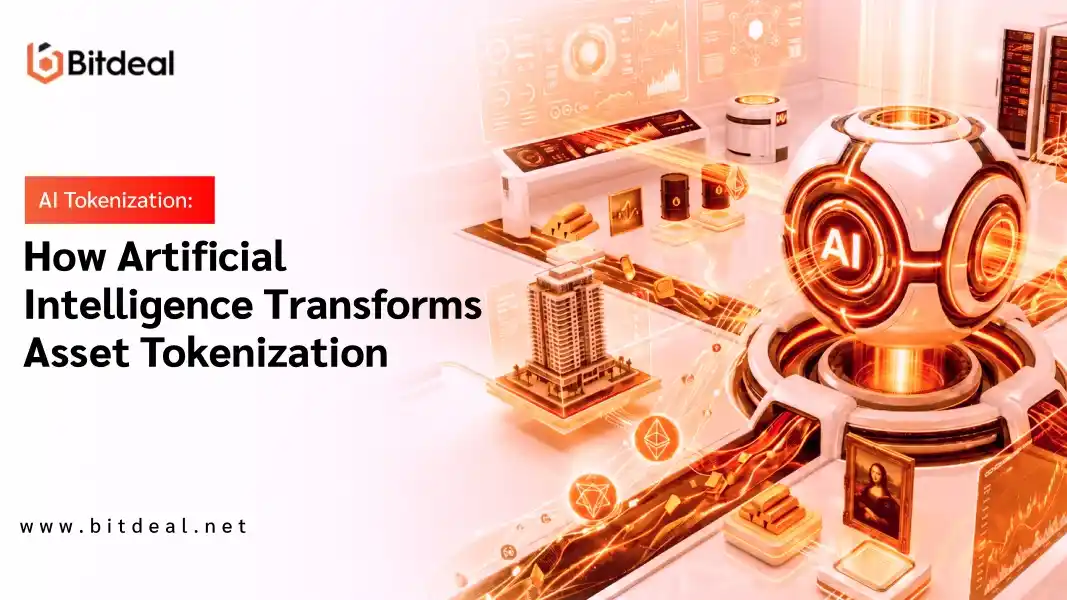
AI tokenization is a way to introduce intelligent decision-making logic into the operation of converting physical assets into blockchain-based tokens. In simple terms, it involves turning the ownership of tangible assets such as real estate, gold, or company shares into digital form, while the AI silently operates in the background performing tasks like verifying data, benchmarking values, or detecting anomalies. As a result, AI becomes the creation and management of digital assets, an increasing number of financial transactions being carried out through digital platforms.
What Is Asset Tokenization?
Asset tokenization is the process of converting ownership of physical assets into a digital form as a token recorded on a blockchain. Instead of relying on physical documents or traditional records, property is tracked in a highly secure digital ledger. Real estate gold stocks, paintings, and copyrights are some examples of such assets.
Each token stands for a fraction of the asset. Ownership of these tokenized assets can be broken down into several smaller parts. It works to simplify the act of buying, selling, or transferring ownership without heavy dependence on paperwork or slow manual procedures. Also, it helps assets which are usually expensive or inaccessible to be co-owned by many investors in smaller units.
Role of Artificial Intelligence in Tokenization
Artificial intelligence plays an important part in making asset tokenization more structured and data-driven. It helps process large amounts of information, reduce manual effort, and support better decision-making across different stages of token creation and management.
Data Analysis and Decision Support
AI systems can study large sets of financial, market, and asset-related data in a short time. This helps in understanding asset value, demand patterns, and market behavior before creating tokens.
Asset Valuation Assistance
AI tools can estimate the value of an asset by looking at historical prices, current market conditions, and external factors. This is useful for assets like real estate, stocks, or digital items where prices may change over time.
Fraud Detection and Risk Identification
AI can detect unusual patterns in transactions or ownership records. If something does not match expected behavior, the system can flag it for review. This helps reduce the chances of fraud or incorrect data entering the system.
Document Processing and Verification
Many assets require legal documents for ownership proof. AI can read and process these documents, extract important details, and compare them with existing records. This reduces manual checking and saves time.
Compliance Monitoring
Tokenization must follow legal rules depending on the region. AI systems can scan transactions and activities to check whether they align with required guidelines. This helps maintain proper regulatory standards during asset trading and issuance.
Benefits of Combining AI with Blockchain
Better Data Understanding
AI can study large amounts of data related to assets, transactions, and market trends. This helps in understanding patterns that may not be easy to notice manually. When combined with blockchain records, this information is reliable for decision-making.
Stronger Fraud Detection
Blockchain keeps records that cannot be easily changed, and AI adds an extra layer by identifying unusual activity. If something looks suspicious in transaction patterns or ownership changes, AI can flag it for review, reducing fraud actions.
Clear Ownership Records
Blockchain stores ownership details in a transparent way, while AI helps organize and interpret these records. This makes it easier to track who owns what and how ownership has changed over time.
Faster Data Processing
AI can process large sets of blockchain data and extract useful insights quickly. This helps systems respond to changes in market conditions or asset behavior without long delays in analysis.
Smarter Asset Management
With AI handling analysis and blockchain storing verified records, asset management becomes more structured. Investors and organizations can make decisions based on clear data rather than scattered information.
Real-World Use Cases of AI Tokenization
1. Tokenized Real Estate
Large real estate portfolios are now being divided into digital tokens, allowing broader investor participation.
In one major case, DAMAC Group in the UAE worked with blockchain platforms to tokenize around $1 billion worth of property assets, including real estate projects, hospitality assets, and infrastructure.
AI plays a role by:
- Studying property prices using market data and past trends.
- Supporting identity checks for global investors.
- Processing legal and compliance information for cross-border participation.
2. Tokenized Fixed Income and Treasury Assets
Traditional financial instruments like treasury bills and money market funds are also being brought onto blockchain systems.
Examples include BlackRock’s BUIDL fund and Franklin Templeton’s tokenized money market products. These represent short-term government securities and cash-like instruments in digital form.
AI contributes by:
- Monitoring portfolio data in real time.
- Supporting risk analysis for institutional investors.
- Handling investor onboarding checks and documentation review.
3. Tokenized Commodities (Gold and Oil)
Precious metals and energy resources are also being represented as digital tokens.
Gold-backed tokens like PAX Gold and Tether Gold represent physical gold stored in vaults, where each token corresponds to a fixed amount of gold. Oil tokenization is also being explored in pilot projects within commodity trading.
AI supports this area through:
- Price estimation using global market signals.
- Monitoring supply chain and storage data.
- Detecting unusual activity in custody and movement records.
4. Tokenized Private Credit
Private lending markets are being transformed through tokenization, especially in emerging markets and fintech platforms.
Companies like Goldfinch, Centrifuge, and Figure Technologies work with loan-based assets such as invoice financing, small business loans, and real estate-backed credit.
AI is used for:
- Assessing borrower risk using alternative data.
- Tracking loan performance over time.
- Identifying unusual repayment patterns.
How to Enter the AI Tokenization Market?
Entering the AI tokenization market begins with learning how blockchain and artificial intelligence work together in asset digitization. It would be helpful to decide on a sector such as real estate, finance, or commodities for recognizing the ways you can turn assets into digital tokens. To create tokens, one would need a blockchain platform, while AI could be used for valuation, risk assessment, and document handling. Many companies choose to work with a trustable provider like Bitdeal, an AI Token development company, for designing and implementing tokenization solutions. Remaining updated with market trends and AI advancements is a good way to ensure continual growth in this area.
Get A Demo
We are glad to announce that, Bitdeal is making one more milestone in its journey. As Web3 technologies becomes more dominant and lucrative, bitdeal sets its footmark in AI and Gaming Space. Explore our all-new AI and Gaming Solutions below here.