


Blog | AI Solutions
Narrow AI vs Generative AI: The Future of Australian Fintech
Explore how Narrow AI and Generative AI are shaping the future of Australian fintech—enhancing automation, personalization, and innovation across financial services.
- Blogs

Narrow ai vs generative ai
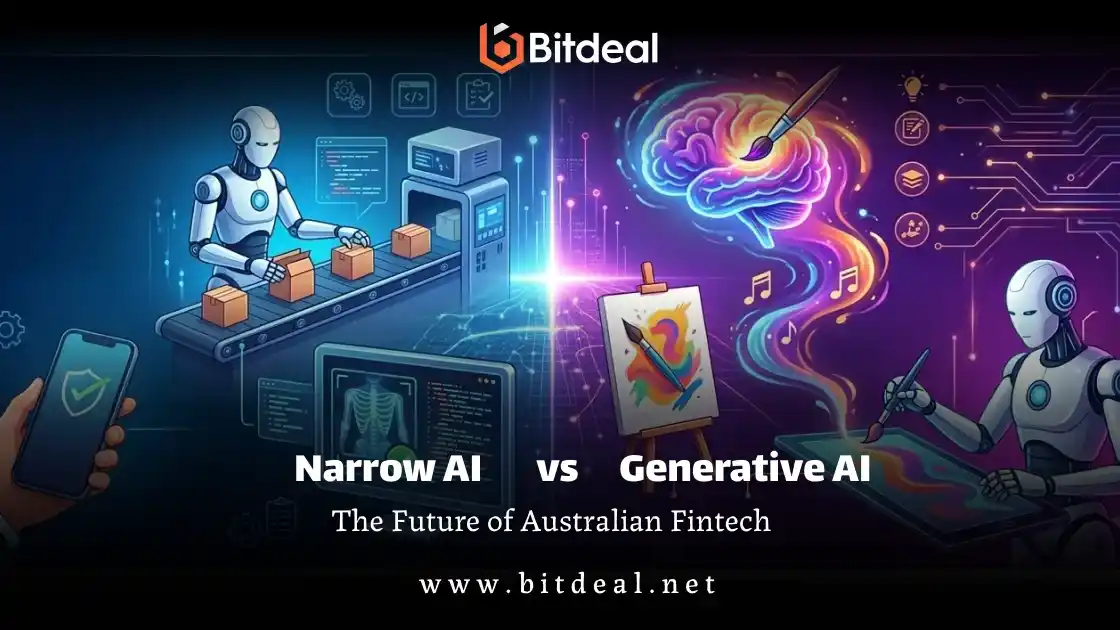
Narrow AI and generative AI are reshaping Australian fintech in 2026. With operations powered largely by narrow AI, nearly 70% of tasks achieve high precision in fraud detection and credit scoring across major banks like CommBank and NAB. Generative AI is rapidly gaining ground, powering personalized advice and synthetic data amid ASIC's new AI ethics guidelines. Narrow AI excels in real-time tasks with 95% accuracy rates, while Gen AI boosts innovation through chatbots and risk reports in Australia's $52B fintech sector. This divide reflects global trends but accelerates locally due to APRA compliance demands.
What Is Narrow AI in Fintech
Narrow AI in fintech refers to specialized machine-learning systems built to perform specific tasks such as fraud detection, credit scoring, risk analysis, or algorithmic trading. These systems operate within defined rules and data sets, focusing on accuracy, speed, and efficiency in targeted financial operations. This approach is widely used by banks and fintech firms to automate core processes and reduce operational risks.
How Generative AI Differs From Narrow AI in Fintech
In fintech, generative AI expands on task-specific automation by creating new insights, content, and solutions from large financial datasets. It can generate personalized financial advice, draft compliance reports, simulate risk scenarios, and power intelligent conversational banking experiences. Unlike narrow AI, which is limited to predefined functions like fraud detection or credit scoring, generative AI adapts to multiple use cases and produces dynamic, context-aware outputs. This makes it valuable for innovation, customer engagement, and accurate decision-making across modern fintech platforms.
How Narrow AI Currently Dominates Australian Fintech
Proven ROI and Operational Efficiency
Narrow AI is the leader among Australian fintechs in 2026 because of its proven ROI, compatibility with existing legacy systems, and regulation adherence as per APRA and ASIC guidelines. Its anticipated automation allows banks to reduce costs and raise efficiency in their core operations.
High Accuracy in Critical Financial Tasks
Specialized narrow AI models can achieve an accuracy level of more than 95% in functions that are critical, such as the regions of fraud detection and real-time credit scoring. Such precision helps Narrow AI fraud detection systems in Australia, which are already in use by the leading financial institutions worldwide.
Widespread Adoption Across Financial Operations
Narrow AI is behind nearly 76% of financial reporting processes that exceed the global average. This indicates the increasing importance and use of AI in Australian financial services for their automation, regulatory compliance, and analytics.
Lower Risk Compared to Experimental AI
In contrast to generative AI, which has just a 9% adoption rate in fintech, narrow AI guarantees results that are predictable with low latency. This steadiness makes Narrow AI Fintech Australia a top choice for those financial institutions that are cautious.
The Rise of Generative AI in Australia’s Financial Sector
Rapid Growth in Adoption
Generative AI is taking Australia's financial sector to the next level, with usage jumping from 9% to 52%, with a prediction that it will be a top priority for financial reporting by 2027. This change aligns with the general trend of the Fintech AI Australia 2026, which is focused on automation and smart decision-making.
Expansion of AI-Powered Banking Services
Leading banks such as CommBank are utilizing AI agents for dealing with customer queries, fraud detection, and loan processing. These innovations show the increasing impact of generative AI in Australian banking by improving service speed and personalization.
Synthetic Data for Smarter Credit Decisions
Generative AI is used to generate synthetic datasets that improve the precision of models of risk and lending across financial systems. With generative AI development, this method is leading to the transformation of generative AI credit scoring in both banking and fintech platforms.
Regulatory Support for Safe AI Scaling
ASIC's AI ethics policy is a positive signal for financial institutions to proceed with generative AI in a responsible way. Therefore, this gives momentum to AI in the Australian financial services sector while at the same time guaranteeing that institutions remain compliant and transparent.
Shift Toward Autonomous Financial Operations
Using generative AI, more than 80% of businesses have moved beyond simple chatbots and are gradually moving their finance and risk management functions to autonomous agents for faster, smarter, more efficient, and scalable decision-making.
Key Use Cases: Narrow AI vs Generative AI in Fintech Operations
Fraud Detection
Narrow AI: The AI is capable of carrying out real-time anomaly scanning with a level of accuracy above 95%; therefore, immediate suspicious transactions are flagged by simple rule-based models.
Generative AI: The generative AI can support its functions by simulating synthetic attacks and providing natural language alerts that describe hazards.
Credit Scoring
Narrow AI: Narrow AI employs predictive models that consider thousands of data points, which means APRA-compliant loan approval processes are achieved.
Generative AI: Generative AI upgrades this system by using a generative AI credit scoring method, which is capable of creating synthetic datasets and personalized loan narratives.
Customer Service
Narrow AI: Narrow AI is a source of power for RPA chatbots and rule-based systems that can address 80% of standard inquiries, such as balance checks and transaction history requests.
Generative AI: Generative AI through advanced language models aids the customer with environmental responses, dynamic FAQs, and customized financial advice.
Regulatory Reporting
Narrow AI: Narrow AI has the ability to run KYC and AML processes, extract data from, and validate information present in millions of documents every single day.
Generative AI: Generative AI can be used for creating narrative risk reports and reducing complex reports to understandable, executive-friendly insights.
Risk Management
Narrow AI: Narrow AI makes use of financial data from the past and also regulatory standards for its scenario modeling and stress testing.
Generative AI: Generative AI is capable of coming up with alternative scenarios and supports conversational, what-if analysis that allows for even more in-depth strategic planning.
The Future of Australian Fintech: Convergence of Narrow and Generative AI
Hybrid AI Models for Smarter Operations
Hybrid AI systems will define Australian fintech by 2027, merging Narrow AI’s precision with Generative AI’s creativity to unlock $15B in productivity gains under APRA’s AI sandbox.
Agentic Models for Real-Time Insights
Banks like Westpac develop agentic models where narrow AI handles real-time fraud detection while GenAI auto-generates regulations and personalized wealth strategies.
Unified Customer Engagement
Open Banking 2.0 allows combined systems that predict customer loss with Narrow AI and craft specific retention offers using Gen AI, achieving conversion lifts up to 85%.
Safe and Compliant Scaling
ASIC’s updated ethics framework supports safe deployment of hybrid AI, positioning Australia ahead of APAC competitors while allowing tokenization of real-world assets.
Enterprise Adoption and Innovation
By 2028, 65% of enterprises are expected to adopt hybrid AI, using sovereign LLMs and narrow AI edge computing to create autonomous financial agents that cut costs 35% while boosting innovation.
Conclusion
The integration of narrow AI and generative AI is transforming the Australian fintech sector by allowing smarter operations, personalized services, and fully automated workflows. Hybrid AI systems provide a perfect combination of efficiency, compliance, and innovation that helps enterprises reduce operating costs while still leveraging the $52B fintech ecosystem for growth.
Choosing an AI development company that aligns with your needs is a decisive step towards molding secure, scalable, and AI solutions fit for the future. Bitdeal is one of the best AI service providers in the industry. They have delivered multiple AI-powered fintech platforms that include automation, compliance, and advanced analytics solutions that fit banks and fintechs alike.
Get A Demo
We are glad to announce that, Bitdeal is making one more milestone in its journey. As Web3 technologies becomes more dominant and lucrative, bitdeal sets its footmark in AI and Gaming Space. Explore our all-new AI and Gaming Solutions below here.