


Blog | AI Solutions
Complete 2026 Guide to AI App Development Costs for Businesses
This complete guide explains AI app development costs in 2026, covering key cost factors, pricing breakdowns, popular use cases, ROI metrics, and practical ways to reduce development expenses.
- Blogs

Ai app development costs for businesses
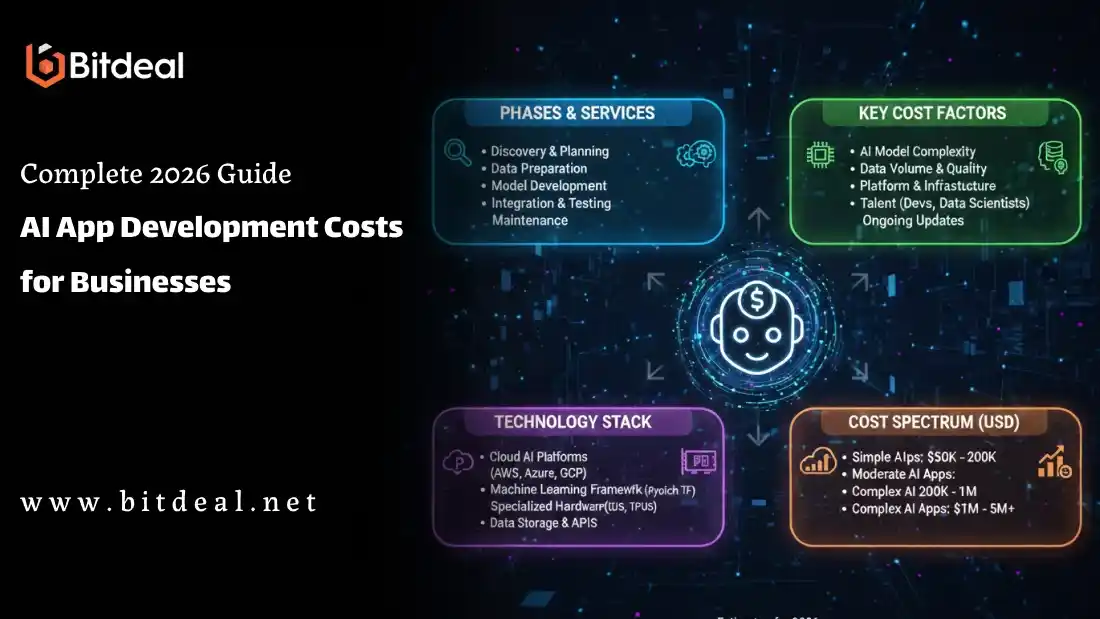
AI app development costs in 2026 are rising fast, with prices growing 40–60% year-over-year. MVP apps now typically cost between $150K and $500K, while full-scale enterprise AI apps can reach $1M+, due to developments like NVIDIA’s Nemotron Speech and TII’s Falcon-H1R models. These advanced agentic AI and multimodal AI applications require more powerful computing and skilled talent, but smart planning can reduce costs by up to 30% while delivering up to 5x ROI. This guide will break down the factors driving costs, provide a detailed cost breakdown, showcase key use cases, and share tips to budget effectively for AI app development in 2026.
Why AI App Development Costs Are Changing in 2026
AI app development costs are evolving quickly in 2026, driven by advanced technologies, increased demand, and the need for more advanced solutions. The rise of agentic AI app pricing and multimodal AI development expenses means companies are investing in smarter, more capable applications that can handle complex tasks and provide richer user experiences.
Factors like higher compute requirements, specialized talent, and integration with existing systems are pushing budgets upward. At the same time, businesses are focusing on efficiency, modular designs, and strategic planning to manage AI app development costs effectively in 2026. As a result, while initial investments may be higher, the potential returns and competitive advantage make these AI applications a valuable long-term investment.
7 Key Factors Driving AI App Development Costs in 2026
Several critical factors influence how much building an AI app will cost in 2026, from technology choices to team expertise.
1. Complexity of AI Models
The type of AI used, such as agentic AI or multimodal systems, affects cost. More advanced models require complex design, training, and optimization, which increases development budgets.
2. App Functionality and Features
Apps with extensive features, integrations, or real-time capabilities demand more resources. The more features available, the higher the time and cost required to deliver a strong solution.
3. Development Team Expertise
Hiring skilled AI engineers, data scientists, and UX designers significantly impacts budgets. Working with a top AI app development company guarantees access to experienced professionals who can design scalable architectures. reduce rework, and accelerate time-to-market.
4. Data Requirements and Management
AI depends on high-quality, well-structured data. Costs rise when large datasets must be collected, cleaned, and labeled for training, especially for multimodal AI development expenses.
5. AI Infrastructure and Cloud Services
High-powered computers, GPUs, and cloud resources for training and deployment contribute heavily to development costs. Efficient resource planning can help control expenses.
6. AI MVP Build and Iterations
Developing a minimum viable product (MVP) allows businesses to test features before full-scale deployment. Typical AI MVP build costs vary depending on model complexity and performance requirements.
7. Maintenance, Monitoring, and Updates
AI apps require continuous monitoring and optimization after launch. Regular updates, bug fixes, and performance improvements are essential for long-term reliability and ROI.
AI App Development Cost Breakdown
Understanding how costs of different kinds are distributed is beneficial for planning AI app development projects for 2026.
Planning And Strategy
The beginning stages involving research, requirement gathering, or creation of a roadmap provide a basic structure to an AI app. Budgeting for strategy helps.
Design and Prototyping
UI/UX design, wireframes, and interactive prototypes are also factored into the amount. This is an important aspect that guarantees a user-friendly UI/UX design.
AI Model Development
Development and training of the AI models may be the most expensive phase. This is because of the involvement of factors such as the preparation of the dataset, the choice of the models, and the testing process, and this is particularly true of undertaking AI application development services.
Frontend and Backend Development
The app’s UI and its implementation in servers, databases, and AI would require expert coders. Complexity and functionalities would impact costs directly.
Testing and QA
Testing the app thoroughly guarantees that it works correctly, it's free of bugs, and it actually scales well. The role of quality assurance is critical, as it can prevent the need for cost escalation at a later date.
Deployment and Hosting
These include cloud infrastructure, security, and setup costs. Planning and scalability of cloud services are crucial in minimizing costs while still delivering efficient performance.
Maintenance and Upgrades
The application after launch is supported and monitored to ensure it remains accurate and up-to-date. The efforts ensure long-term ROI is achieved, for example, an enterprise AI app ROI in 2026.
Top 5 Popular Use Cases for AI Apps in 2026
In 2026, AI apps are being adopted across industries to solve real business problems and deliver measurable outcomes.
1. AI-Powered Customer Support
AI apps are widely used for chatbots, voice assistants, and automated support systems. These applications handle customer queries instantly, reduce response time, and improve overall service efficiency.
2. Predictive Analytics for Business Decisions
AI apps help organizations analyze large datasets to predict demand, customer behavior, and market trends. This allows for smarter planning and faster, informed decision-making.
3. Healthcare and Medical Assistance Apps
AI in healthcare apps supports diagnosis, patient monitoring, and personalized treatment recommendations. They improve accuracy while reducing the workload on medical professionals.
4. Finance and Fraud Detection Applications
AI apps monitor transactions in real time to detect anomalies and prevent fraud. These solutions help financial institutions minimize risk and enhance security.
5. Personalized Recommendation Systems
From online shopping to social media platforms, AI app development allows personalized content and product suggestions. This increases user engagement, sales, and long-term customer retention.
8 Proven Tips to Slash AI App Development Costs
Through clever planning and execution of AI app development, costs can be lowered without sacrificing quality and performance.
1. Begin with a Problem Statement
A clear problem statement eliminates unwanted features and reduces work. A set of focused goals stays on track and affordable from day one.
2. Create an MVP First
Starting with a minimum practical product is useful for validating concepts early on. This guarantees that less money is wasted on unproven functionalities.
3. Pick the Right AI Models
It is not necessary that every app involves advanced and state-of-the-art models. The appropriate level of intelligence can thus be used to manage costs related to computing and development efforts.
4. Use Existing Frameworks and APIs
By using ready-to-use libraries, APIs, and open source, we improve development time and reduce engineering effort.
5. Optimize Data Usage
High-quality, relevant data is relatively less expensive compared to large databases that are unfiltered. Data preparation that is efficient cuts the expenses associated with infrastructure.
6. Architect for Scalability
It's a lot cheaper to design scalable systems from the beginning than to have them rebuilt. The architecture should be modular; hence, growth can be gradual without major reinvestment.
7. Follow a Structured Development Approach
Building an AI Application Step by step, planning, prototyping, testing, and scaling provide significant benefits in directing the team clear of delays and costly mistakes.
8. Monitoring Performance post-launch
Continuous monitoring detects inefficiencies in their early stages. This helps optimize in time to reduce maintenance and operational costs over a long period of time.
AI Apps ROI: Long-Term Benefits and Real Metrics
Apart from the investment, the application of AI apps provides long-term value for which the investment is logical.
Increased Operational Efficiency
AI applications automate daily tasks and business processes, leading to getting the same work done faster and equally well across various teams.
Cost Savings Over Time
Although the cost of development may be high in the beginning, reduced errors and labor dependency in AI apps lead to significantly lower long-term costs.
Revenue Growth and Conversion Uplift
Personalization, prediction, and engagement excellence drive conversion rates and CLV. The decision made by artificial intelligence often leads to a revenue increase.
Increased Accuracy of Decision Making
AI apps involve the analysis of large amounts of data in real time, thus allowing leaders to make informed, assumption-free decisions on the basis of patterns and predictions developed from the data.
Scalability Without Linear Cost Increase
After that, once these AI applications have been deployed, they have the ability to scale and handle more users or data without any increase in costs.
Competitive Advantage and Market Readiness
Companies that use AI apps are more agile in responding to changes in the marketplace and consumer demand. This is because organizations are more likely to be one step ahead of competitors, making them more "future-ready."
Conclusion
AI app development in 2026 requires careful budgeting, strategic planning, and a clear understanding of long-term value. While rising costs are caused by advanced models, infrastructure, and talent needs, businesses that focus on the right use cases, MVP-first approaches, and cost-optimization strategies can achieve strong and sustainable returns. Collaborating with an experienced AI development company like Bitdeal helps businesses handle complexity with confidence. From cost planning to deployment and optimization, Bitdeal delivers future-ready AI solutions that balance innovation, performance, and ROI—making AI app investments smarter and more impactful in 2026 and beyond.
Get A Demo
We are glad to announce that, Bitdeal is making one more milestone in its journey. As Web3 technologies becomes more dominant and lucrative, bitdeal sets its footmark in AI and Gaming Space. Explore our all-new AI and Gaming Solutions below here.