


Blog | Cryptocurrency
Custodial vs. Non-Custodial Wallets: Which Crypto Wallet Is Right for You?
This blog explains custodial and non-custodial crypto wallets in 2026, highlighting key differences, security, privacy, and ownership best practices. It covers regulatory compliance, KYC/AML considerations, and lists the top 10 hardware and software wallets.
- Blogs

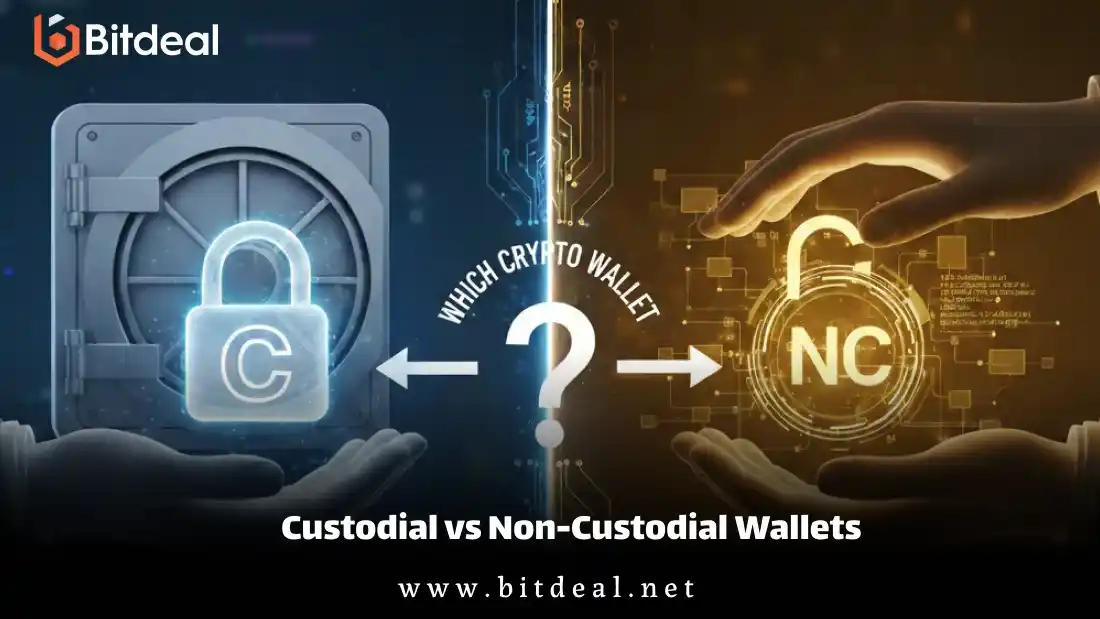
Custodial vs non custodial wallets
What Is a Custodial Crypto Wallet?
A custodial crypto wallet is where a third party, such as a crypto exchange or service provider, holds and manages your digital assets on your behalf. Many platforms offering a cryptocurrency wallet development service integrate these custodial wallets to simplify asset management for users. This means that users do not have direct access to their private keys, as the platform takes full responsibility for storage, transactions, and account recovery.
One important consideration when using custodial wallets is custodial wallet risks. Since asset control is centralized, users must trust the provider’s security practices, operational integrity, and compliance standards. If the platform faces hacks, downtime, or regulatory actions, user funds may be affected.
In general, a wallet security comparison shows that custodial wallets trade ownership control for convenience. While they often implement strong security layers like insurance and monitoring, the lack of direct key ownership makes them fundamentally different from self-managed wallet models.
What Is a Non-Custodial Crypto Wallet?
A non-custodial crypto wallet gives users full ownership and authority over their digital assets without depending on a third party. In this model, only the wallet owner can access and manage funds, as the wallet provider does not store private credentials. This approach is widely used by experienced users who value autonomy and transparency in crypto management.
One of the key advantages of non-custodial wallets is private key control, which guarantees that users alone can authorize transactions and safeguard their assets. This structure significantly reduces dependency on external platforms and aligns with the core principles of decentralization.
Popular non-custodial wallet examples include browser-based wallets, mobile wallets, and hardware wallets that integrate directly with decentralized applications. These wallets allow users to interact with blockchain networks while maintaining full custody of their funds.
Key Differences: Custodial vs. Non-Custodial Wallets
Here’s a clear, side-by-side breakdown to understand how custodial and non-custodial wallets differ in terms of control, security, and usage.
Custodial Wallets
Third-Party Asset Management
The wallet provider controls and safeguards user funds, handling storage, transactions, and system maintenance on the user’s behalf.
No Direct Key Ownership
Users do not manage private passwords themselves, which reduces responsibility but also limits direct control over assets.
Simplified Account Recovery
Access can usually be restored through customer support, identity verification, or email-based recovery mechanisms.
Beginner-Friendly Experience
Designed with intuitive interfaces, custodial wallets look like traditional banking or fintech apps, making onboarding easier.
Platform Dependency
Users depend on the provider’s operational stability, security infrastructure, and regulatory compliance for uninterrupted access.
Non-Custodial Wallets
User-Owned Asset Control
Funds are managed directly by the wallet holder without relying on any centralized authority or service provider.
Full Responsibility on Users
Users must securely store recovery phrases or keys, as lost access cannot be restored by a third party.
Permissionless Transactions
Transactions can be executed anytime without approval, allowing effortless interaction with blockchain networks.
Decentralization-Oriented Design
These wallets are built to support trustless systems and direct engagement with decentralized applications.
Greater Operational Freedom
Users can manage assets across multiple networks and platforms without restrictions imposed by intermediaries.
Security, Privacy, and Ownership: 2026 Best Practices
By 2026, the security of crypto wallets will no longer be only about protection; rather, it's going to be a balance of safety, privacy, and actual ownership in a decentralized environment.
Security Best Practices
Wallets should have advanced encryption, secure authentication layers, and continuous threat monitoring to ensure safety from evolving cyber risks. Strong security design maintains much-reduced exposure while making it as usable as any other wallet.
Privacy-First Design
New wallets try to minimize the collection of personal data and avoid the storage of centralized data as much as possible. This helps in keeping the users free while transacting without the tracking of unwanted attention or identity exposure.
Ownership and Asset Control
Most of the best practices today revolve around who has control over the user's assets at given system updates, failures, or policy changes. Clear ownership models also let a user know who can access and what conditions are required.
Future-Ready Wallet Architecture
Wallets for 2026: The wallets are designed to adapt to the challenges in shifting regulatory environments and multichain ecosystems while consistently meeting required standards of security and privacy.
Regulatory Compliance and Legal Considerations in 2026
As the regulations in the crypto industry evolve around the world, the wallets and users in the year 2026 need to adapt to these regulations in order to provide secure services. A well-designed cryptocurrency wallet development solution ensures that platforms remain compliant while offering strong security and a smooth user experience.
Global Regulatory Framework
Regulations regarding the custody of digital assets and the financial transparency of their usage by the end-users are being established. However, the platforms providing the wallets must function according to the jurisdiction established.
KYC/AML Compliance Requirement KYC
Most of the custodian services used today are required to comply with, Know Your Customer and Anti-Money Laundering rules. The idea behind these rules is to guarantee a trustworthy operation and combat money laundering.
Data Protection and User Rights
The compliance also covers the collection, storage, and processing of data from users. The wallet providers are also expected to follow the data protection laws in handling users' information.
Custody and Liability Frameworks
Regulators are now more focused on who takes responsibility during asset loss, platform failure, or security breaches. This is where precise custody definitions come into play.
Preparing for Future Regulations
The future wallet solution has flexible architectures with respect to compliance. This makes it possible to easily adjust to changes in laws.
Best Wallet for You: Beginners, Traders, HODLers
Choosing the right crypto wallet depends on your experience level, usage patterns, and long-term goals in the evolving 2026 crypto ecosystem.
For Beginners
Beginner-friendly wallets focus on ease of use, simple setup, and guided navigation to reduce the learning process. These wallets often resemble traditional fintech apps and help users get started without deep technical knowledge.
Examples: Coinbase Wallet, Binance Wallet, Trust Wallet
For Active Traders
Traders need wallets that support quick transactions, effortless exchange connectivity, and multi-asset management. Speed, liquidity access, and real-time balance visibility are key factors here.
Examples: MetaMask (with exchange integrations), OKX Wallet, Bybit Wallet
For Long-Term HODLers
HODLers prioritize long-term asset safety and ownership over daily convenience. Wallets in this category are designed for secure storage and give users full authority through private key control, reducing dependence on third parties.
Examples: Ledger, Trezor, SafePal
Top 10 Crypto Wallets 2026 (Hardware + Software)
In 2026, there are separate advantages for hardware and software wallets that cater to different levels of cryptocurrency users, whether it be beginners or expert HODLers.
Hardware Wallets (Cold Storage)
Ledger Nano X
Bluetooth-equipped and supporting multi-chain functionality, it is ideal for the true HODLers among us. It is mobile-managed and secures assets even offline.
Trezor Model T
Friendly interface with advanced encryption and backups. It has a touch display to make creating a Trezor account and verifying transactions seamless.
SafePal S1
Portable, user-friendly, and working with more than 10,000 assets. The wallet’s closed system allows the user to swap cryptocurrency without revealing their private keys.
Ellipal Titan
Completely sealed and protected from all internet threats for ultimate safety. Created for high-value assets, it signs transactions using the QR code system; all of this takes place in offline mode.
BitBox02
Lightweight and easy to use. Great if you need a secure storage solution when offline. Two-chip design improves the device’s misuse resistance. An excellent choice for cryptocurrency storage
Software Wallets (Hot Wallets)
MetaMask
A browser extension with mobile support, great for DeFi traders and NFT collectors. Supports multi-network functionality, allowing users to smoothly connect to dApps and smart contract development.
Trust Wallet
Handles multiple tokens, staking, and basic interaction with DeFi. The Web3 browser feature allows access to decentralized exchanges and NFT marketplaces without leaving the wallet.
Coinbase Wallet
It is beginner-friendly and established within the Coinbase family of products. Coinbase Wallet allows for the easy conversion of dollars to cryptocurrency, but holds the funds in user-manageable wallets
Binance Wallet
Smooth integration with Binance Exchange for traders. Features real-time portfolio monitoring and fast transfers for Binance-supported tokens.
Exodus Wallet
User-friendly design, portfolio management capabilities, and multi-asset management. It has an integrated exchange function, which allows the asset exchange directly through the Exodus wallet interface.
Choosing Your Wallet: Step-by-Step 2026 Guide
Choosing the best cryptocurrency wallet in 2026 is going to depend on the needs and wallet security. This is the best way to personally decide which wallet will serve the best purposes.
Step 1: Identify Your Usage Type
Categorize yourself as a beginner, an active trader, or an HODLer. A beginner can make do with basic wallets that have custodial services. An HODLer would find it more convenient to have a wallet that promotes a secure handling of his or her private keys with
Step 2: Security Features Assessment
Look out for multi-layer authentication, encryption features, and the availability of backups. In case it’s possible, perform a comparison of wallet security features to determine the efficiency of the wallet in resisting hacks and unauthorized access.
Step 3: Check Asset Support
Make sure your wallet is compatible with all cryptos you want to invest in or exchange. Multi-chain wallets facilitate the management of diversified portfolios without requiring multiple apps.
Step 4: Test the User Experience and Accessibility
Evaluate the interface, availability on mobile or desktop, and compatibility with exchanges or dApps. A trader may want speed, whereas a holder may just want simplicity.
Step 5: Case Analysis: Regulation vs. Recovery
When using a custody wallet, it is essential to be aware of the KYC/AML process and how account restoration takes place. When using a non-custodial wallet, it is important to store the recovery phrases in a secure way to avoid losing them
Step 6: Explore Advanced Features
Search for wallets that support staking, DeFi, NFT, and multi-signature wallets. These functions should suit your investment and engagement plans.
Conclusion
Choosing the right crypto wallet in 2026 is essential for balancing security, control, and convenience. Whether you prefer a custodial wallet for ease of use or a non-custodial wallet for full independence, understanding your needs, risk tolerance, and long-term goals is key.
For businesses and individuals looking to build or integrate secure wallet systems, partnering with a cryptocurrency wallet development company like Bitdeal guarantees professional-grade solutions, smooth integration, and advanced security features. With expert guidance, you can implement a strong wallet strategy that meets both regulatory standards and user expectations, empowering safe and efficient crypto management.
Get A Demo
We are glad to announce that, Bitdeal is making one more milestone in its journey. As Web3 technologies becomes more dominant and lucrative, bitdeal sets its footmark in AI and Gaming Space. Explore our all-new AI and Gaming Solutions below here.